

What can modes do?
Each Mode is tailored to a specific role or mindset. For example:- Ask Mode: Optimized for speed and responsiveness, using minimal tools in read-only mode. Great for quick questions and exploration.
- Code Mode: A full-featured generalist with access to all available tools, capable of writing code, running workflows, and reasoning through multi-step tasks.
- Plan Mode: Ideal for high-level planning, system design, complex understanding, and exploring architectural trade-offs.
Getting started
How to use modes
To use a mode, select it from the mode dropdown menu in the bottom-left corner of Qodo IDE Plugin. Once selected, the mode stays active across messages, adapting to your session’s needs and maintaining context as you go. You can either create a new mode or use Qodo’s ready-to-use default modes.Create a new mode
To create a new mode:1
From Qodo’s chat input, click the bottom left drop-down.
2
Click “Add new mode”.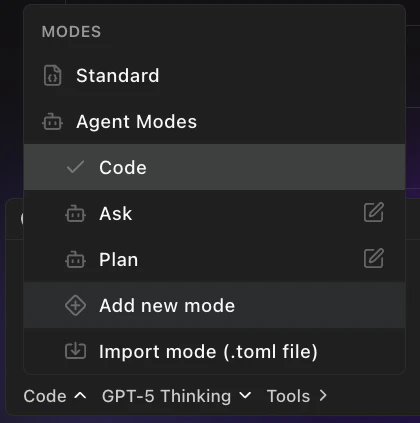
3
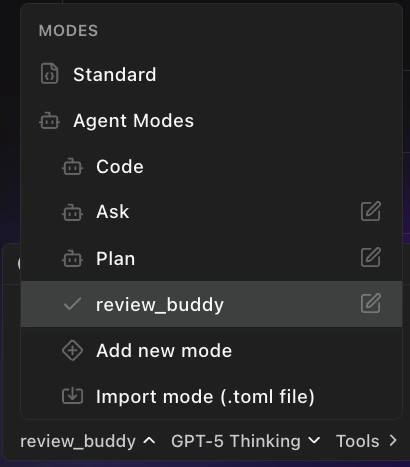
Name your mode (e.g.,
review_buddy)4
Prompt: Enter natural language instructions for your mode to follow. For example: “Provide feedback during development to help me follow style guidelines, spot issues early, and write cleaner code.”
5
MCP Tools: From the list, select which MCP tools the mode should have access to (e.g.,
filesystem, github, shell).6
Preferable model: From the list, select a preferable AI model for your workflow to use.
7
Click the Add mode button.
Sharing and reusing modes
Qodo makes it easy to collaborate by letting you share and reuse custom modes across your team.-
Share Button: Click the share button in a mode’s configuration page to share your mode. This allows you to export the mode’s configuration as a
.tomlfile, so others can easily import and use it in their environment. -
Import mode from file: From the mode creation menu, upload a
.tomlfile to import an existing mode into Qodo.