> ## Documentation Index
> Fetch the complete documentation index at: https://docs.qodo.ai/llms.txt
> Use this file to discover all available pages before exploring further.
# Cross-repository code review
> Detect breaking changes across repository boundaries before they reach production. Define relationships between repositories and let Qodo review every relevant pull request automatically.
Beta
Multi-tenant
Single-tenant
Cross-repository code review extends Qodo's code review to catch breaking changes across repository boundaries before they reach production. In distributed systems, these are the hardest bugs to find: a function signature change in a shared library, an API contract shift, or a schema evolution can all pass single-repository review cleanly because the reviewer has no visibility into the other repositories in the relationship.
Relationships between repositories are discovered automatically by Qodo or defined manually by your team, and every relevant pull request (PR) is reviewed across repository boundaries automatically. Relationships can span Git providers, so teams working across multiple platforms are covered by a single review process.
## How cross-repository code review works
1. **PR opens**: A developer opens a PR in a repository with a defined relationship.
2. **Qodo identifies connected repositories**: Qodo identifies the connected repositories in the relationship.
3. **Agent traces impact**: The agent reads the related repositories and traces the impact in both directions: code that depends on the change, and code in the PR that may conflict with the other repository (for example, by passing the wrong parameters).
4. **Finding surfaces**: If a breaking change is detected, a `Cross-repo` conflict finding appears in the PR with a direct link to the affected lines in the related repository.
5. **Developer acts**: The developer reviews the impact and decides how to proceed: update their changes, coordinate with the affected team, or accept the breaking change.
**Target a specific branch or PR in the other repository**
By default, Qodo targets the main branch of each connected repository. To point the review at a different branch or pull request, include a link to that branch or PR (in the other repository) in your PR description, or in a ticket linked to the PR. The cross-repository agent extracts the target branch from the branch or PR URL.
## When a cross-repository code review runs
When you add a relationship, Qodo analyzes both repositories and classifies the type automatically. It uses that context to determine what to check on every subsequent PR. You do not need to configure triggers.
A review runs when a PR modifies a component covered by a defined relationship, for example:
* An exported function or class in a shared library or SDK.
* A REST API endpoint signature or response contract.
* A database schema or data model consumed by other services.
* An infrastructure or configuration file used across repositories.
* A pipeline or build artifact consumed downstream.
The review runs on any PR in a repository that has at least one active relationship.
## Relationship types
When Qodo classifies a relationship, it assigns one of the following types. The type is informational and does not change what the agent checks. The agent uses the full relationship context to detect breaking changes.
| Type | Description |
| ------------ | --------------------------------------------------------------------------------------------------------------------------- |
| **Code** | One repository imports, calls, or depends on code exported by the other, such as a shared library, SDK, or utility package. |
| **Service** | One repository calls an API or service exposed by the other, such as a frontend calling a backend REST API. |
| **Data** | Both repositories share a database, schema, or data store, such as two services reading from the same database. |
| **Pipeline** | One repository depends on a build artifact, container image, or pipeline output produced by the other. |
| **Other** | The relationship does not fit one of the above types. |
## Where cross-repository findings appear
Cross-repository findings appear alongside standard Qodo review findings in the PR, tagged as `Cross-repo`.
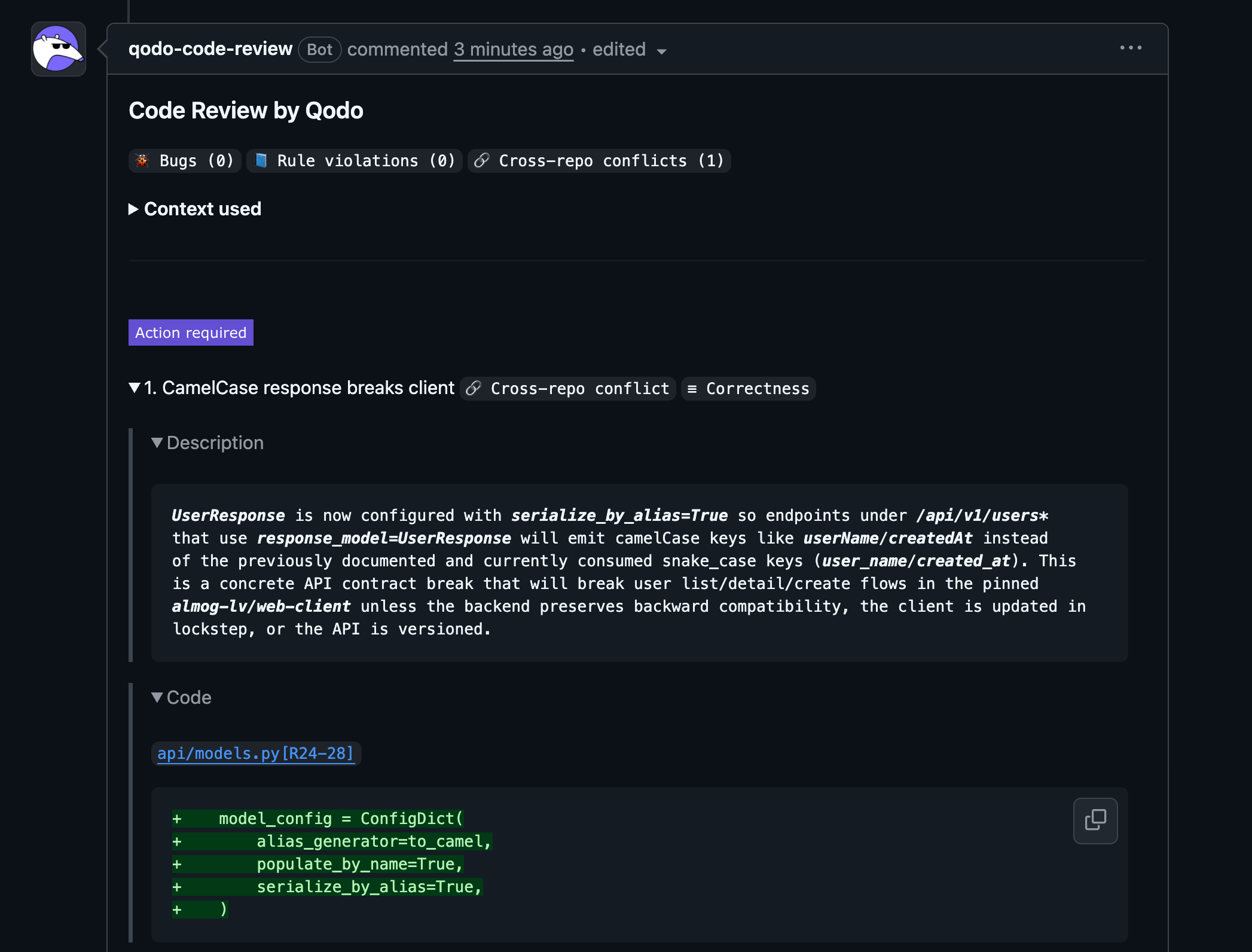 They also appear on the Findings page in the Qodo portal with the same tag.
To view how cross-repository conflicts are displayed in the pull request, see [View cross-repository conflicts in your findings](/code-review/view-cross-repo-conflicts-in-findings).
## Related resources
* [Manage cross-repository relationships](/governance/cross-repo-code-review/repository-relationships): Define relationships between your repositories.
* [Manage code review across repositories](/governance/repositories): View and manage your repositories and installations.
* [Monitor organization-wide PR findings](/governance/view-all-findings-in-organization): Monitor cross-repository findings across your organization.
They also appear on the Findings page in the Qodo portal with the same tag.
To view how cross-repository conflicts are displayed in the pull request, see [View cross-repository conflicts in your findings](/code-review/view-cross-repo-conflicts-in-findings).
## Related resources
* [Manage cross-repository relationships](/governance/cross-repo-code-review/repository-relationships): Define relationships between your repositories.
* [Manage code review across repositories](/governance/repositories): View and manage your repositories and installations.
* [Monitor organization-wide PR findings](/governance/view-all-findings-in-organization): Monitor cross-repository findings across your organization.