> ## Documentation Index
> Fetch the complete documentation index at: https://docs.qodo.ai/llms.txt
> Use this file to discover all available pages before exploring further.
# Prioritize findings using Relevance
> Relevance shows how likely a finding is to matter, based on how your team has handled similar findings in past pull requests.
Beta
GitHub
GitLab
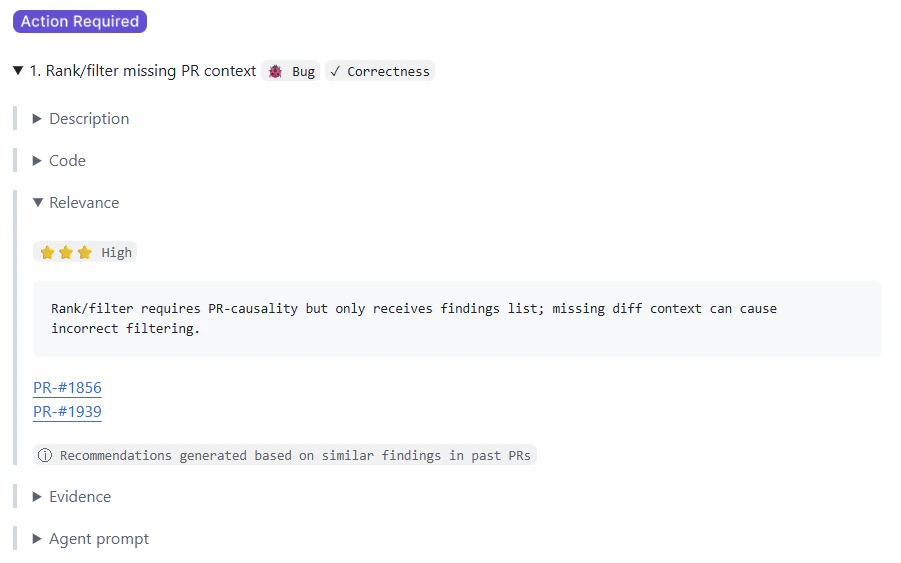
The **Relevance** section highlights related pull requests with similar findings from past reviews. This provides historical context by linking to previous pull requests where a similar issue was discussed, accepted, or rejected, so you can judge whether a finding is worth acting on without digging through history yourself.
 ## How relevance is classified
Each finding gets a relevance classification based on how similar findings were handled in past pull requests:
* ⭐⭐⭐ **High**: Similar findings were typically accepted or fixed.
* ⭐⭐ **Medium**: Mixed or inconclusive history.
* ⭐ **Low**: Similar findings were typically ignored.
## What's in an entry
Each Relevance entry includes:
* A relevance classification (High, Medium, or Low)
* A brief explanation of the historical pattern
* Links to relevant past pull requests
* An indicator that the insight was generated from similar findings
## How this is calculated
Relevance is powered by [PR history](/core-concepts/pr-history), Qodo's mechanism for analyzing your team's pull request activity. This isn't a one-time score: as your team merges new pull requests and makes new review decisions, Qodo keeps learning, so relevance classifications stay aligned with how your standards evolve rather than reflecting a stale snapshot.
## Get started
To view Relevance on a finding:
Ensure your repository is integrated with Qodo (GitHub or GitLab).
Open a pull request reviewed by Qodo.
Expand an issue finding to view the Relevance section, which includes links and context from similar past pull requests.
No additional configuration is required during the beta phase.
## Related resources
* [Understanding PR history](/core-concepts/pr-history): Learn how Qodo builds the historical understanding behind relevance.
* [Code Review Anatomy](/code-review/comment-anatomy): See how Relevance fits into the rest of a finding's structure.
* [Rule Miner](/governance/rule-enforcement/rule-miner): See how the same pull request history also powers rule generation in governance.
## How relevance is classified
Each finding gets a relevance classification based on how similar findings were handled in past pull requests:
* ⭐⭐⭐ **High**: Similar findings were typically accepted or fixed.
* ⭐⭐ **Medium**: Mixed or inconclusive history.
* ⭐ **Low**: Similar findings were typically ignored.
## What's in an entry
Each Relevance entry includes:
* A relevance classification (High, Medium, or Low)
* A brief explanation of the historical pattern
* Links to relevant past pull requests
* An indicator that the insight was generated from similar findings
## How this is calculated
Relevance is powered by [PR history](/core-concepts/pr-history), Qodo's mechanism for analyzing your team's pull request activity. This isn't a one-time score: as your team merges new pull requests and makes new review decisions, Qodo keeps learning, so relevance classifications stay aligned with how your standards evolve rather than reflecting a stale snapshot.
## Get started
To view Relevance on a finding:
Ensure your repository is integrated with Qodo (GitHub or GitLab).
Open a pull request reviewed by Qodo.
Expand an issue finding to view the Relevance section, which includes links and context from similar past pull requests.
No additional configuration is required during the beta phase.
## Related resources
* [Understanding PR history](/core-concepts/pr-history): Learn how Qodo builds the historical understanding behind relevance.
* [Code Review Anatomy](/code-review/comment-anatomy): See how Relevance fits into the rest of a finding's structure.
* [Rule Miner](/governance/rule-enforcement/rule-miner): See how the same pull request history also powers rule generation in governance.