> ## Documentation Index
> Fetch the complete documentation index at: https://docs.qodo.ai/llms.txt
> Use this file to discover all available pages before exploring further.
# How Qodo code review works
> Qodo combines multi-agent review, deep repository context, and continuous learning to deliver high-signal, actionable feedback on every pull request.
Qodo accelerates code reviews and improves the quality of your applications by surfacing bugs and issues in your code. Qodo integrates seamlessly into your Git workflows, helping you review and understand AI-generated code. It ensures that every line of code in production aligns with best practices and meets your organization's engineering standards.
As AI generates more code, reviewing that code safely requires more than generic checks or long lists of comments. Qodo is built for that shift.
## What the review surfaces
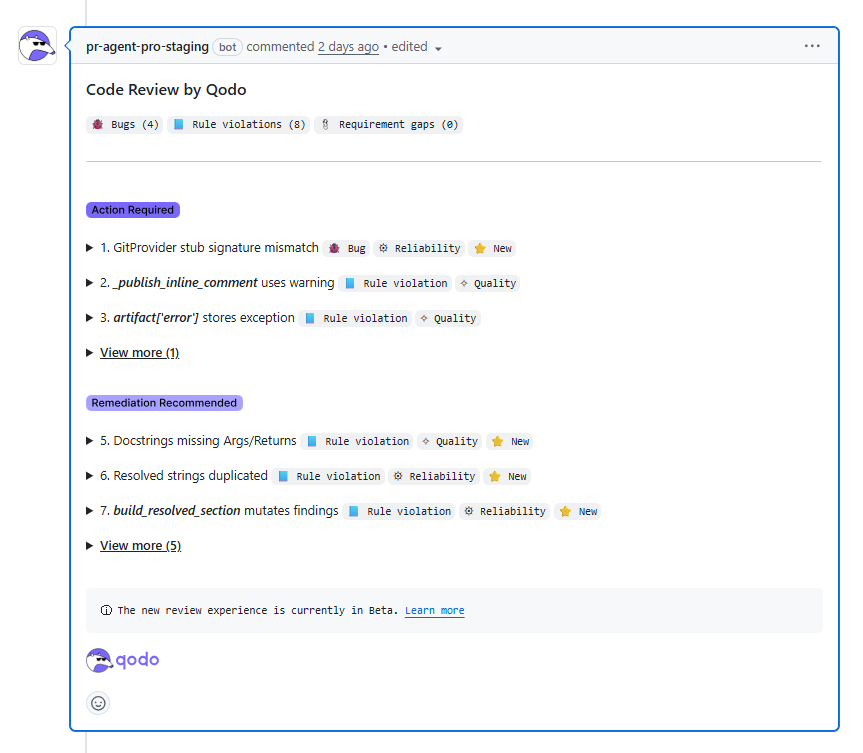
Qodo analyzes pull requests using specialized review agents that evaluate code from multiple perspectives. These agents surface findings such as:
* **Bugs:** Logic errors, edge cases, and anti-patterns in the change.
* **Rule violations:** Deviations from your organization's standards.
* **Requirement gaps:** Where a pull request misses its linked spec.
* **UX deviations:** Where the implementation diverges from linked Figma designs.
* **Cross-repository conflicts:** Breaking changes that affect related repositories.
* **Skill-related findings:** Issues raised by your repositories' skills.
These agents draw on four sources of context: your full codebase and its architecture, your [pull request history](/code-review/concepts/pr-history), linked tickets and requirements, and your organization's standards and policies. They assess changes as a principal software architect would, not as isolated diffs.
## Findings you can act on
For each finding, Qodo explains:
* What needs attention
* Why it matters
* How to move forward
All feedback appears directly inside your pull requests, where you already work.
 ## Accuracy without noise
Qodo is designed to deliver both high recall and high precision. Combining multiple review agents with shared context lets Qodo catch what a single-pass review misses, while filtering out low-impact or irrelevant comments before they reach the pull request.
This precision keeps improving over time: Qodo continuously learns from how your team has handled similar findings in the past, so review feedback stays aligned with how your team actually works, not just generic best practices.
The result is a review experience you trust and act on.
## Review Standards in code review
At the core of the code review experience are Qodo's [Review Standards](/governance/review-standards).
Review Standards capture your organization's conventions from multiple sources, including your codebase, pull request history, and defined requirements. They continuously evolve over time and serve as a single source of truth for how code should be written and reviewed.
During every pull request, Qodo's review agents apply these Review Standards in context. This ensures feedback is consistent, relevant, and aligned with how your organization actually builds software, not generic best practices.
## Next steps
* [Use Qodo in pull requests](/code-review/use-qodo-in-prs): Trigger a review and see where feedback appears.
* [Anatomy of a finding](/code-review/comment-anatomy): See a finding's severity, evidence, and recommended fix.
* [Code Review capabilities and FAQ](/code-review): Browse the full capability index and answers to common questions.
## Accuracy without noise
Qodo is designed to deliver both high recall and high precision. Combining multiple review agents with shared context lets Qodo catch what a single-pass review misses, while filtering out low-impact or irrelevant comments before they reach the pull request.
This precision keeps improving over time: Qodo continuously learns from how your team has handled similar findings in the past, so review feedback stays aligned with how your team actually works, not just generic best practices.
The result is a review experience you trust and act on.
## Review Standards in code review
At the core of the code review experience are Qodo's [Review Standards](/governance/review-standards).
Review Standards capture your organization's conventions from multiple sources, including your codebase, pull request history, and defined requirements. They continuously evolve over time and serve as a single source of truth for how code should be written and reviewed.
During every pull request, Qodo's review agents apply these Review Standards in context. This ensures feedback is consistent, relevant, and aligned with how your organization actually builds software, not generic best practices.
## Next steps
* [Use Qodo in pull requests](/code-review/use-qodo-in-prs): Trigger a review and see where feedback appears.
* [Anatomy of a finding](/code-review/comment-anatomy): See a finding's severity, evidence, and recommended fix.
* [Code Review capabilities and FAQ](/code-review): Browse the full capability index and answers to common questions.